Antisocial Networking
We received a Google+ invitation last night from a Stinquer, which was very kind, but since Google won’t yet allow Google+ participation from Google-managed domains like stinque.com, we had to decline.
We probably would have declined anyway, since Google+ also doesn’t allow pseudonyms, like “Nojo”. Instead we would have to use a Real Name, which takes all the fun out of it, unless we chose a real name like, oh, “Mike Lee”, which could be a lot of fun, especially since we’ve long said that Mike Lee is a Fucking Asshole, and we’re really looking forward to the defamation lawsuit.
Besides, it’s not like we need Yet Another Social Network to join and forget. We’ve had accounts on Friendster, MySpace, LinkedIn and Facebook, and we’ve roundly ignored all of them. We don’t find them useful or interesting. Some time back, a high school friend emailed us, pointedly asking why we had blocked him from our Facebook updates. Nothing of the sort, we responded. We simply hadn’t posted anything for a year.
The exception, if you insist on calling it one, is Twitter. We don’t consider it an exception, since we don’t consider Twitter a social network. It certainly had that tinge at first, but aside from the increasingly (and blessedly) rare Foursquare check-in, we’re not hearing much these days about what strangers had for breakfast. Instead, Twitter has become the Web’s messaging system — or, as we prefer to think of it, the Web’s commenting system. All the world’s a blog post, and all the tweeters merely snarkers. And on Twitter, nobody cares if you’re a dog.
The Great Pseudonym Debate has been a raging topic in geek circles the past few weeks, especially since Google started hamfistedly enforcing Real Names for Google+ accounts. On the one hand, you have Percy Weasley types arguing that it would promote more civility online if folks were forced to unmask themselves — it’s harder to call Mike Lee a Fucking Asshole if you have to sign your name to it, after all. (Unless the name you sign is also Mike Lee, but who on Earth would do that?) And on the other hand, there are very good arguments that for some people, pseudonyms are the only way they can speak in public — domestic-violence victims and political protesters in despot-ruled countries are the typical examples.
There’s even a third hand — these are alien-loving geeks, after all — that argues that pseudonyms are a foundational part of geek culture, starting with the first username you chose to log into your school’s timeshared TTY. Pseudonyms aren’t just whimsical, they’re structural.
In the end, Google+ is Google’s clubhouse, and they’re free to set whatever stupid rules they want. And if, someday, we end up joining Google+ like all the rest, we can be confident of one thing:
We’ll ignore that account, too.
Nous sommes tout Mike Lee.
I am so joining Google+ (whatever that is) as Mike Lee. I can’t wait to write the profile.
I’m on google+ but I’m not sure why.
@Dodgerblue: I can’t figure it out and don’t have the time or energy to try. I also don’t know how to use the twitters.
@Mistress Cynica: I use Twitter to post items re my day job. I’ve also found that it is very helpful to stay on top of breaking news.
@Mistress Cynica: @Dodgerblue: Twitter makes an excellent newswire, as well as an outstanding penis-transmission enabler.
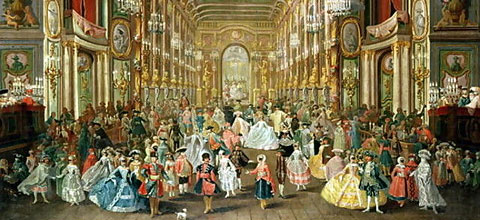
BTW, that picture shows a theatre with its floor raised to stage level so the whole downstairs becomes a dance floor. The colonnade at the back is probably 5 rows of legs done in forced perspective with a painted drop at the back. They would often break through the back wall to add on extra depth to the perspective. It was the usual way to treat big festivities. The whole scene would have been illuminated by candles. The only place I’ve seen this actually recreated is in the ball scene in Jezebel though they don’t tell you what it is. There now.
You’re welcome.
@nojo: So. Twitter, huh? Je suis désolé.
@nojo: The non-asshole Mike Lees of the world have a version of the Santorum problem.
@Benedick HRH KFC: I cropped it. Jakob Rousseau, “Masked Ball in the Hoftheater, Bonn, 1754”. Given the Hoftheater, you’re probably right.
@blogenfreude: There is only one Santorum. Mike Lee is large, he contains multitudes.
@nojo: Twitter is now letting me upload pics of my dick work-related photos without going through a third-party app. Think how much easier Rep. Wiener’s life would have been.
@Benedick HRH KFC: I’m watching Jezebel right now. Truly one of the most lavish productions I’ve ever seen. The sets and costumes are beyond gorgeous.
@nojo:Darling, of course I’m right. I count eight legs but that doesn’t mean the last few aren’t painted. All those people. Thinking how pretty they are, how well dressed, how fortunate.
@blogenfreude: I don’t think there is such a thing, is there?
@Dodgerblue: I must find out more about these twitters of which you speak. Can one use a pencil?
@¡Andrew!: I just saw it the other day. Isn’t it something? The clothes are by Orrey-Kelly. But the detail in the design and production is really extraordinary. Hope you enjoy it as much as I did.
@Benedick HRH KFC: One could probably keep up on current theater news, if one is too impatient to wait for the trades.
@Benedick HRH KFC: Loved it. I’m re-watching the ballroom scene now. The chandelier budget alone must’ve been greater than that of most US cities. And what an incredible, furious, career-making performance by Bette Davis! Personally, I love black and white films, but had it been in color it would’ve rivaled Gone with the Wind.
@Benedick HRH KFC: I’ve seen so many magnificent classics recently. I especially love film noir, and my favorites are Double Indemnity, Mildred Pierce and Sunset Boulevard.
Oh, and Sullivan’s Travels. Veronica Lake is spectacular!
@¡Andrew!: All good. Do you know The Lady Eve? Stanwyck and Fonda. My fave Preston Sturges movie. Fonda is either falling over or Stanwyck is tripping him.
I think Davis is a touch too old for Julie but she’s pretty damn fine. Fonda gets better as it goes on. Wait till you see what happens.
Also, have we all seen Mr. Skeffington?
@Dodgerblue: I just spent months researching the theatre in that period. I can bore on the subject for hours. And most probably will.
@nojo: On the other hand, you can get your whole name on a vanity plate if you want … few can make that claim.
FLYINGCHAINSAW • TRUMP: MACHINE GUNNING ORPHANAGES AND CONVENTS BY ME IS CONSTITUTIONAL AND SOMETIMES IT MAKES ME ERECT WITHOUT PHARMACEUTICAL ASSISTANCE! Sen. sENEMA has a career ahead of her in giving designer psychedelic enemas to trust-fund…
MANCHUCANDIDATE • TRUMP: MACHINE GUNNING ORPHANAGES AND CONVENTS BY ME IS CONSTITUTIONAL AND SOMETIMES IT MAKES ME ERECT WITHOUT PHARMACEUTICAL ASSISTANCE! @¡Andrew!: She thought three's company. Nope.
¡ANDREW! • TRUMP: MACHINE GUNNING ORPHANAGES AND CONVENTS BY ME IS CONSTITUTIONAL AND SOMETIMES IT MAKES ME ERECT WITHOUT PHARMACEUTICAL ASSISTANCE! Gawd hates SIN, specifically Kyrsten SINema.
¡ANDREW! • TRUMP: MACHINE GUNNING ORPHANAGES AND CONVENTS BY ME IS CONSTITUTIONAL AND SOMETIMES IT MAKES ME ERECT WITHOUT PHARMACEUTICAL ASSISTANCE! So long, Senatard Glitter-trash. I hope she knows how much everyone H8s her :0)
¡ANDREW! • TRUMP: MACHINE GUNNING ORPHANAGES AND CONVENTS BY ME IS CONSTITUTIONAL AND SOMETIMES IT MAKES ME ERECT WITHOUT PHARMACEUTICAL ASSISTANCE! The racist kleptocratic MSM is really gonna have to crank up the bread and circuses now that their…
FLYINGCHAINSAW • TRUMP: MACHINE GUNNING ORPHANAGES AND CONVENTS BY ME IS CONSTITUTIONAL AND SOMETIMES IT MAKES ME ERECT WITHOUT PHARMACEUTICAL ASSISTANCE! @¡Andrew!: Ted Kazinski Sec of Interior Only the DEAD are extreme enough to serve in DONNIE…
¡ANDREW! • TRUMP: MACHINE GUNNING ORPHANAGES AND CONVENTS BY ME IS CONSTITUTIONAL AND SOMETIMES IT MAKES ME ERECT WITHOUT PHARMACEUTICAL ASSISTANCE! @FlyingChainSaw: Department of Health & Human Services: Charles Manson Defense Secretary:…
FLYINGCHAINSAW • TRUMP: MACHINE GUNNING ORPHANAGES AND CONVENTS BY ME IS CONSTITUTIONAL AND SOMETIMES IT MAKES ME ERECT WITHOUT PHARMACEUTICAL ASSISTANCE! @¡Andrew!: Right, the administration's all star line up: Pres: Trump VP: Ted Kaczynski…
FLYINGCHAINSAW • TRUMP: MACHINE GUNNING ORPHANAGES AND CONVENTS BY ME IS CONSTITUTIONAL AND SOMETIMES IT MAKES ME ERECT WITHOUT PHARMACEUTICAL ASSISTANCE! @FlyingChainSaw: Actually, FDLE would be the first to admit it. The state banks on it with 'sue me…
¡ANDREW! • TRUMP: MACHINE GUNNING ORPHANAGES AND CONVENTS BY ME IS CONSTITUTIONAL AND SOMETIMES IT MAKES ME ERECT WITHOUT PHARMACEUTICAL ASSISTANCE! I cannot wait for the Republinazi MAGAt trash to DEMAND that $hitler be allowed to be president…